10 Powerful Life Lessons from the Bhagavad Gita for Daily Life
The Bhagavad-gita is one of the most profound spiritual scriptures in the world. It is a sacred dialogue between Lord Krishna and Arjuna, taking place on the battlefield of Kurukshetra. At that moment, Arjuna is confused, fearful, and unable to decide what is right. Seeing his condition, Lord Krishna imparts divine knowledge that not only guides Arjuna but also serves as a universal guide for all humanity.
The teachings of the Gita are not limited to religion or philosophy—they provide practical solutions to everyday problems such as stress, confusion, fear, attachment, and lack of purpose. Even today, in our fast-paced and challenging lives, the wisdom of the Gita helps us live with clarity, confidence, and inner peace.
Here are top 10 powerful lessons from the Bhagavad Gita for a peaceful & successful life.
1. Focus on Duty, Not Results

What does Bhagavad Gita teach about duty and karma?
Shloka (2.47):
"You have a right to perform your prescribed duty, but you are not entitled to the fruits of action. Never consider yourself to the cause of the results of your activities, and never be attached to not doing your duty."
If we leave our prescribed duties and only try to do devotion, it does not help in real purification. But when we do our prescribe duty properly along with devotion, we grow spiritually much faster. So, doing our duty is very important.
We should focus on our actions and efforts, not on the results, because the results are always in Krishna’s hands. No matter how hard we work, the outcome may not always be as we expect. Still, we should happily accept whatever result we get, because it is part of Krishna’s plan and is ultimately best for us. Our happiness should come from doing our duty sincerely, not from the results.
Lord Krishna teaches that we should perform our duties sincerely without worrying about the results. When we focus too much on outcomes, we become anxious and stressed. But when we focus on our effort, we feel peaceful and motivated.
👉 This lesson encourages us to work hard, stay dedicated, and leave the results to God. It removes fear of failure and builds confidence.
2. Control the Mind to Control Your Life

How does Bhagavad Gita explain mind control and overthinking?
Shloka (6.5):
"A man must elevate himself by his own mind, not degrade himself. The mind is the friend of the conditioned soul, and his enemy as well."
In material existence one is subjected to the influence of the mind and the senses. In fact, the pure soul is entangled in the material world because the mind is involved with the false ego, which desires to lord it over material nature. Therefore, the mind should be trained so that it will not be attracted by the glitter of material nature, and in this way the conditioned soul may be saved. One should not degrade oneself by attraction to sense objects. The more one is attracted by sense objects, the more one becomes entangled in material existence. The best way to disentangle oneself is to always engage the mind in Kṛṣṇa consciousness. The word hi is used for emphasizing this point, i.e., that one must do this. It is also said:.
mana eva manuṣyāṇāṁ
kāraṇaṁ bandha-mokṣayoḥ
bandhāya viṣayāsaṅgo
muktyai nirviṣayaṁ manaḥ
“For man, mind is the cause of bondage and mind is the cause of liberation. Mind absorbed in sense objects is the cause of bondage, and mind detached from the sense objects is the cause of liberation.”
Therefore, the mind which is always engaged in Kṛṣṇa consciousness is the cause of supreme liberation.
👉 The mind has great power—it can either uplift us or destroy us. If we control our thoughts, we can achieve success and peace. If we let our mind wander, it leads to confusion and negativity.
3. The Soul is Eternal (You Are Not the Body)

What does Bhagavad Gita say about the soul and death?
Shloka (2.20):
"For the soul there is never birth not death. Nor, having once been, does he ever cease to be. He is unborn, eternal, ever-existing, undying and primeval. He is not slain when the body is slain."
The body is subject to six kinds of transformations. It takes its birth from the womb of the mother’s body, remains for some time, grows, produces some effects, gradually dwindles, and at last vanishes into oblivion. The soul, however, does not go through such changes. The soul is not born, but, because he takes on a material body, the body takes its birth. The soul does not take birth there, and the soul does not die.
In spiritual understanding, we can clearly distinguish between the soul and the body through a simple example. Consider a car and its driver. If the car gets scratched or its glass breaks, the driver is not truly affected. The driver never says, “I am scratched” or “I am broken.” The damage belongs only to the car, not to the person driving it.
In the same way, this body is like a vehicle, and the soul is the driver within. The body may experience birth, growth, disease, and death, but the soul remains untouched by these changes. Just as the driver is different from the car, the soul is completely different from the body.
When the body is hurt, it does not mean the soul is hurt. When the body takes birth, it does not mean the soul is born. And when the body dies, the soul does not die. The soul is eternal, unborn, and indestructible.
The soul simply changes bodies, just as a person changes clothes, but its true essence always remains the same.
Understanding this truth helps us rise above fear, attachment, and sorrow. We begin to realize that our real identity is not this temporary body, but the eternal soul, which is a part of the Supreme Lord, Krishna.
When we deeply realize this, we naturally develop faith and surrender, knowing that no material situation can harm our true self. In devotion, we accept everything as the will of the Lord and remain peaceful, knowing that He is always protecting us. The Gita explains that the soul is eternal—it never takes birth and never dies. The body may change or perish, but the soul continues its journey.
👉 This knowledge removes fear of death and helps us focus on spiritual growth rather than temporary material things.
4. Faith Leads to Knowledge and Peace
Why is faith important in spiritual growth as per Bhagavad Gita?
Shloka (4.39):
"A faithful man who is absorbed in transcendental knowledge and who subdues his senses quickly attain the supreme spiritual peace."
We should live our lives and perform our duties according to the will of Lord Krishna. Just as Arjuna followed the instructions of Krishna and fought the battle, even when his heart was confused and unwilling, we too must learn to follow Krishna’s will with faith and surrender.
In our lives, many situations arise that we do not like or cannot control. But if Krishna has given us a particular situation, we should accept it wholeheartedly. We must have firm faith that Krishna will always protect us and guide us.
Therefore, we should never run away from God in times of trouble. Instead, we should pray for His mercy, chant His holy name, and accept His will with gratitude.
Let our faith be so deep and unshakable that in every situation—good or bad—we remember:
👉 Krishna is always with us, protecting us, guiding us, and loving us.
5. Surrender to Krishna for Inner Freedom

What does surrender to Krishna mean in Bhagavad Gita?
Shloka (18.66):
"Abandon all varieties of religion and just surrender unto Me. I shall deliver you from all sinful reaction. Do not fear."
According to the devotional process, one should simply accept such religious principles that will lead ultimately to the devotional service of the Lord. One may perform a particular occupational duty according to his position in the social order, but if by executing his duty one does not come to the point of Kṛṣṇa consciousness, all his activities are in vain. Anything that does not lead to the perfectional stage of Kṛṣṇa consciousness should be avoided. One should be confident that in all circumstances Kṛṣṇa will protect him from all difficulties. There is no need of thinking how one should keep the body and soul together. Kṛṣṇa will see to that.
One should always think himself helpless and should consider Kṛṣṇa the only basis for his progress in life. As soon as one seriously engages himself in devotional service to the Lord in full Kṛṣṇa consciousness, at once he becomes freed from all contamination of material nature. There are different processes of religion and purificatory processes by cultivation of knowledge, meditation in the mystic yoga system, etc., but one who surrenders unto Kṛṣṇa does not have to execute so many methods. That simple surrender unto Kṛṣṇa will save him from unnecessarily wasting time. One can thus make all progress at once and be freed from all sinful reactions.
Lord Krishna advises complete surrender to Him. When we trust God fully, He guides us and protects us from difficulties.
👉 Surrender does not mean weakness—it means having faith that God has a greater plan for us.
To understand true meaning of Surrender and Krishna's teaching, go deeper with proper guidance. Join our structured Bhagavad Gita Course at Bliss.
Learn the real meaning of Gita step-by-step and learn how to apply them in real life for peace, faith, and clarity.
📘 Join the Bhagavad Gita Basics Course Now (Online Recorded Video Lessons)
6. Practice Self-Discipline
What does Bhagavad Gita say about controlling desires and senses?
Shloka (2.58):
"One who is able to withdraw his senses from sense objects, as the tortoise draws his limbs within the shell, is to be understood as truly situated in knowledge."
The test of a yogī, devotee or self-realized soul is that he is able to control the senses according to his plan. Most people, however, are servants of the senses and are thus directed by the dictation of the senses. That is the answer to the question as to how the yogī is situated. The senses are compared to venomous serpents. They want to act very loosely and without restriction. The yogī, or the devotee, must be very strong to control the serpents – like a snake charmer. He never allows them to act independently. There are many injunctions in the revealed scriptures; some of them are do-not’s, and some of them are do’s. Unless one is able to follow the do’s and the do-not’s, restricting oneself from sense enjoyment, it is not possible to be firmly fixed in Kṛṣṇa consciousness.
The best example, set herein, is the tortoise. The tortoise can at any moment wind up its senses and exhibit them again at any time for particular purposes. Similarly, the senses of the Krishna conscious persons are used only for some particular purpose in the service of the Lord and are withdrawn otherwise. Arjuna is being taught here to use his senses for the service of the Lord, instead of for his own satisfaction. Keeping the senses always in the service of the Lord is the example set by the analogy of the tortoise, who keeps the senses within.
The Gita emphasizes working without selfish motives. When we act only for personal gain, we become bound by results. But when we act selflessly, we become free.
👉 Helping others, serving society, and doing good without expecting rewards purifies our heart.
7. Stay Calm in Happiness and Sorrow
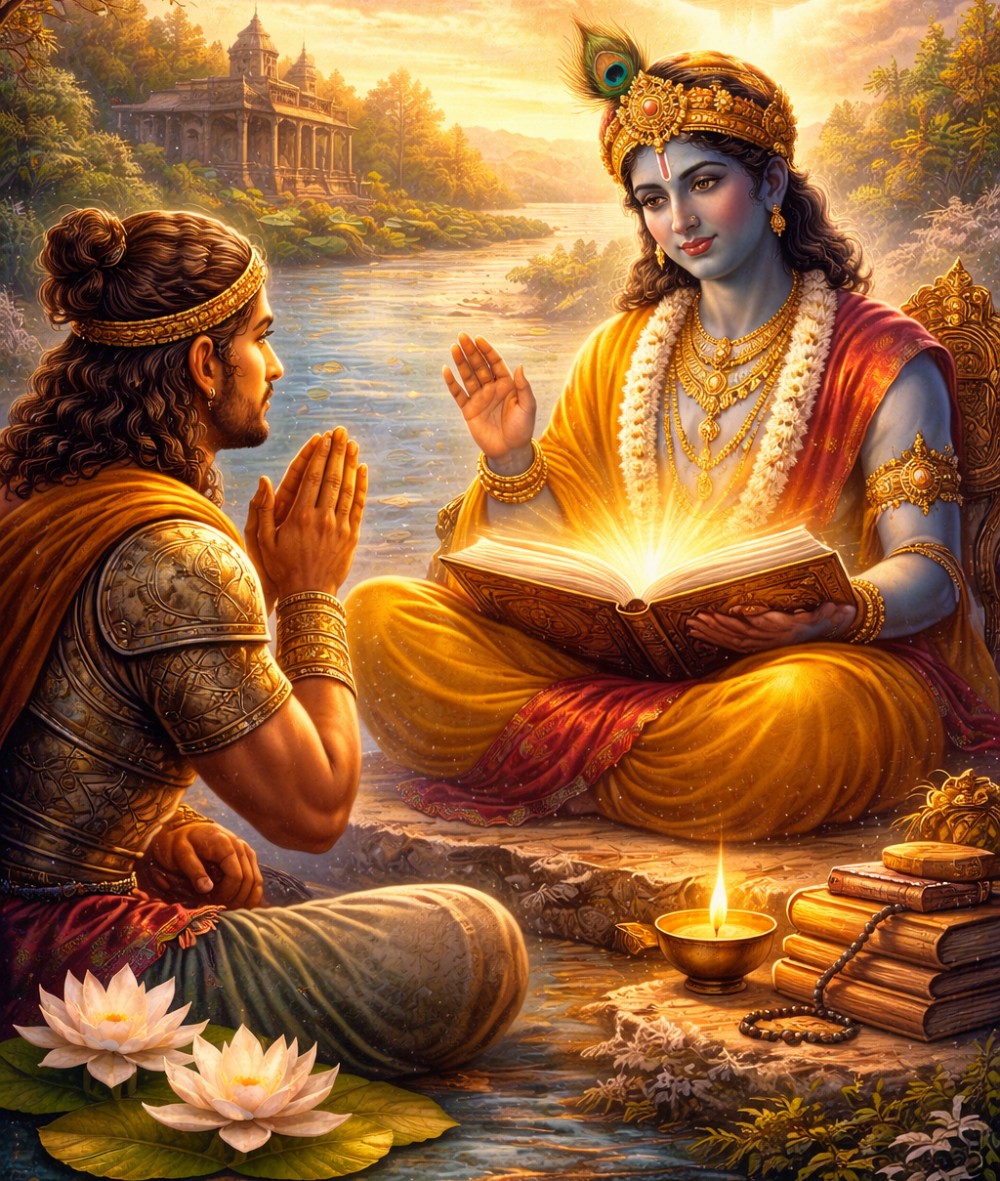
How does Bhagavad Gita help in handling success and failure?
Shloka (2.38):
"Do thou fight for the sake of fighting, without considering happiness or distress, loss or gain, victory or defeat – and, by so doing, you shall never incur sin."
Lord Kṛṣṇa now directly says that Arjuna should fight for the sake of fighting because He desires the battle. There is no consideration of happiness or distress, profit or loss, victory or defeat in the activities of Kṛṣṇa consciousness. That everything should be performed for the sake of Kṛṣṇa is transcendental consciousness; so there is no reaction to material activities. He who acts for his own sense gratification, either in goodness or in passion, is subject to the reaction, good or bad. But he who has completely surrendered himself in the activities of Kṛṣṇa consciousness is no longer obliged to anyone, nor is he a debtor to anyone, as one is in the ordinary course of activities. It is said:
devarṣi-bhūtāpta-nṛṇāṁ pitṝṇāṁ
na kiṅkaro nāyam ṛṇī ca rājan
sarvātmanā yaḥ śaraṇaṁ śaraṇyaṁ
gato mukundaṁ parihṛtya kartam
“Anyone who has completely surrendered unto Kṛṣṇa, Mukunda, giving up all other duties, is no longer a debtor, nor is he obliged to anyone – not the demigods, nor the sages, nor the people in general, nor kinsmen, nor humanity, nor forefathers.” (Bhāg. 11.5.41) That is the indirect hint given by Kṛṣṇa to Arjuna in this verse.
A wise person remains balanced in happiness and sorrow, victory and defeat. Such balance leads to inner strength.
👉 This lesson teaches emotional stability—do not get overexcited in success or depressed in failure.
8. Importance of Devotion (Bhakti Yoga)
Why is devotion (Bhakti Yoga) important according to Bhagavad Gita?
Shloka (9.22):
"But those who worship Me with devotion, meditating on My transcendental form – to them I carry what they lack and preserve what they have."
If we perform devotion to God, even a small amount of sincere devotion can protect us from great dangers. This can be understood through a beautiful example.
Once, there was a very pure and noble Brahmin named Ajamila. In his early life, he faithfully served God with great sincerity. However, due to bad association, he gradually went on the wrong path. He abandoned his righteous duties and began committing sinful activities such as stealing and harming others.
Despite his fallen condition, he named his son “Narayan,” which is one of the holy names of Lord Vishnu. At the time of his death, out of fear, he called out to his son by saying “Narayan.” Although he intended to call his son, he unknowingly chanted the holy name of God.
Because of this, Vishnu duta came, and he was saved from severe consequences. This shows that even a little connection with God—like chanting His name—can protect a person from great danger.
Therefore, we should always have faith that even small acts of devotion can bring powerful blessings and protection in our lives.
Lord Krishna assures that He takes care of those who are devoted to Him with love and faith.
👉 Through devotion—chanting, prayer, and remembrance—we develop a deep connection with God and experience true happiness.
9. Avoid Lust, Anger, and Greed
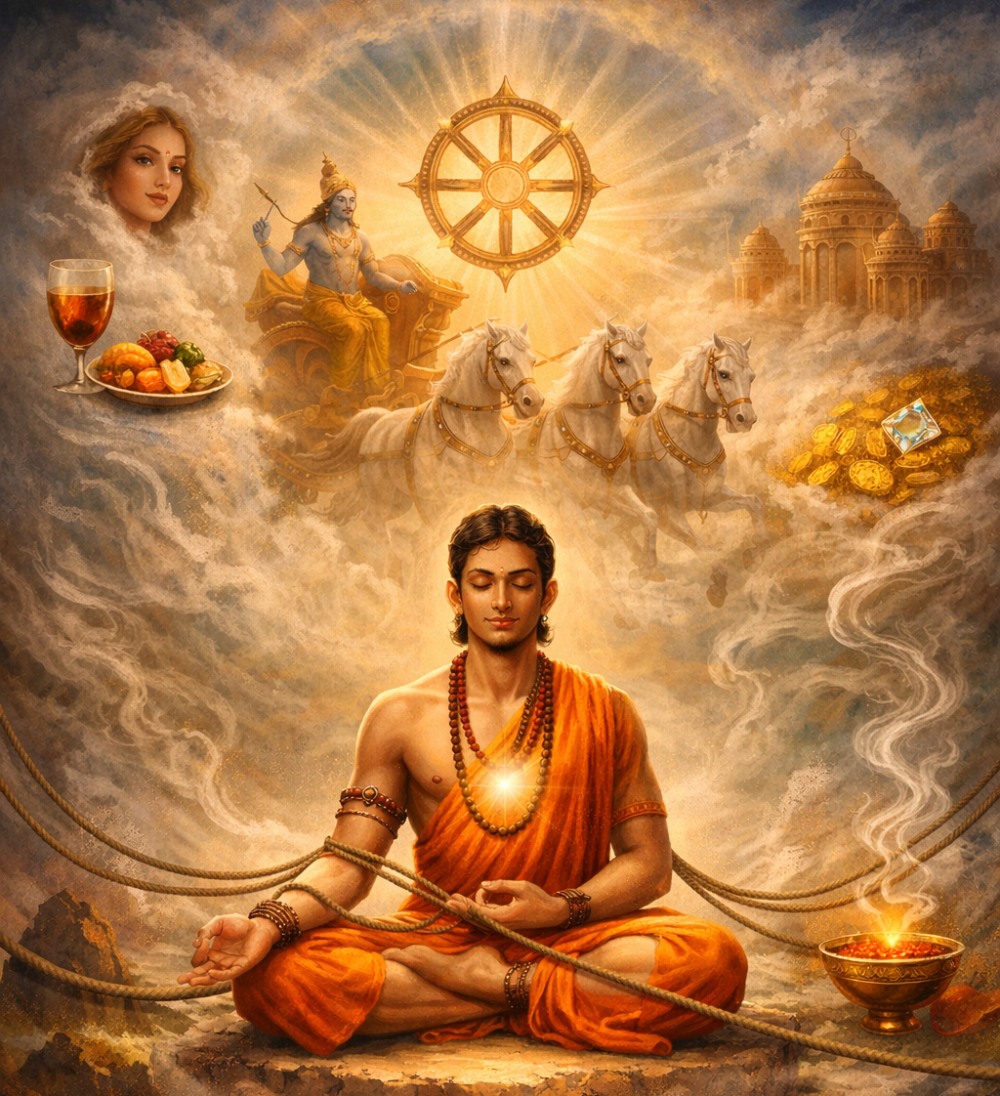
How to overcome lust and anger according to Bhagavad Gita?
Shloka (16.21):
"There are three gates leading to this hell – lust, anger and greed. Every sane man should give these up, for they lead to the degradation of the soul."
In our life, there are six inner enemies—kāma (lust), krodha (anger), lobha (greed), moha (illusion), mada (pride), and mātsarya (envy). Among these, kāma, krodha, and lobha are especially dangerous because they lead a person toward spiritual downfall.
When a person’s desires (kāma) are not fulfilled, it turns into anger (krodha). And when those desires are fulfilled, it often increases greed (lobha)—the craving for more and more. Both anger and greed push a person to commit many wrong actions and disturb their peace of mind. In this way, these qualities gradually pull a person toward suffering.
However, there is a very simple yet powerful solution to overcome these enemies: Engaging ourselves in Krishna consciousness and the loving devotion of God.
When we connect our life to devotion:
✔ Our mind becomes purified
✔ Our senses become controlled
✔ Even these negative tendencies can be transformed into something positive
The key is to engage our senses in the service of God.
We can understand this with a beautiful example:
Hanuman ji showed anger when he burned Lanka, but his anger was not sinful. Why? Because it was used in the service of Lord Rama. This kind of anger is considered divine, not harmful
Lust, anger, and greed are described as the three gates to destruction. These emotions disturb our peace and lead to wrong actions.
👉 By controlling these negative qualities, we can live a pure and peaceful life.
10. Seek True Knowledge from a Spiritual Master
What does Bhagavad Gita say about the right way to gain spiritual knowledge?
Shloka (4.34):
"Just try to learn the truth by approaching a spiritual master. Inquire from him submissively and render service unto him. The self-realized soul can impart knowledge unto you because he has seen the truth."
Therefore, we should not accept just anyone as a spiritual master. As stated in the scriptures, the process of religion is directly established by the Lord Himself. A spiritual master possesses true knowledge of spiritual truth (tattva), and only he can impart this knowledge to us.
We should approach a spiritual master with humility, without pride or desire for prestige, and with a sincere attitude of service. The satisfaction of the spiritual master is the secret of advancement in spiritual life. A true spiritual master sees everything clearly and is always ready to guide and accept sincere service. Through respectful inquiry and service, one can receive perfect knowledge.
A bona fide spiritual master is by nature very kind toward the disciple. Therefore when the student is submissive and is always ready to render service, the reciprocation of knowledge and inquiries becomes perfect.
The Gita encourages us to seek knowledge from a genuine spiritual teacher with humility and sincerity.
👉 True knowledge helps us understand our purpose, our identity, and our connection with God.
Bhagavad Gita clearly teaches that real spiritual knowledge is understood best under proper guidance. BLISS will guide you on the right learning path and help you start your spiritual journey with clarity and confidence.
Book a Free Consultation with Bliss and get personal guidance on how to start your Bhagavad Gita journey in the right way. If you feel confused, stressed, or unsure where to begin, this free consultation will give you a clear spiritual direction and structured learning path.
Conclusion : What are the most practical teachings of Bhagavad Gita?
The teachings of the Bhagavad-gita As It Is are timeless and universal. They guide us not only in spiritual life but also in our daily struggles. By following these principles, we can develop a strong mind, a pure heart, and a peaceful life.
In today’s world, where stress, competition, and confusion are common, the Gita acts like a light that shows the right path. If we apply even a few of its teachings sincerely, we can transform our lives completely.
✨ Hare Krishna Hare Krishna Krishna Krishna Hare Hare,
Hare Rama Hare Rama Rama Rama Hare Hare ✨
If you enjoyed reading this blog, share it with your loved ones and spread the wisdom of the Bhagavad Gita.
🙏 With love and devotion,
🌿 Hare Krishna!