

Control The Mind Before It Controls You: A Gita-Based Reset
Introduction: The Unseen Battle
Why Does the Mind Never Stay Still?
Have you ever felt mentally exhausted even when your body was resting?
Do you often:
• overthink small situations?
• react emotionally and regret it later?
• feel anxious about the future?
• struggle to control negative thoughts?
• feel distracted during important moments?
We often think our greatest enemies are external—competitors at work, difficult relationships, or financial stress. However, in the Bhagavad-gita, Lord Krishna reveals a deeper truth: the most formidable foe resides within.
The mind is described as a double-edged sword. It can be our most loyal friend or our most relentless enemy. When we feel overwhelmed, anxious, or driven by impulses we later regret, it is a sign that the "chariot" of our life is being pulled by wild horses (the senses) because the driver (the mind) has lost its way.
This blog explains how the Bhagavad-gita teaches mind control through spiritual practice, self-awareness, and Krishna consciousness. Learn how overthinking, anger, anxiety, and mental distractions develop — and discover practical methods to achieve inner peace.
This blog explores how to hit the "reset button" using the timeless wisdom of Srila Prabhupada’s Bhagavad-gita As It Is.
The Mechanics of the Mind: Understanding the Mind Through the Gita
To control the mind, we must first understand its nature and its position in our internal hierarchy. Srila Prabhupada explains that the mind is the central hub of all sensory activities.
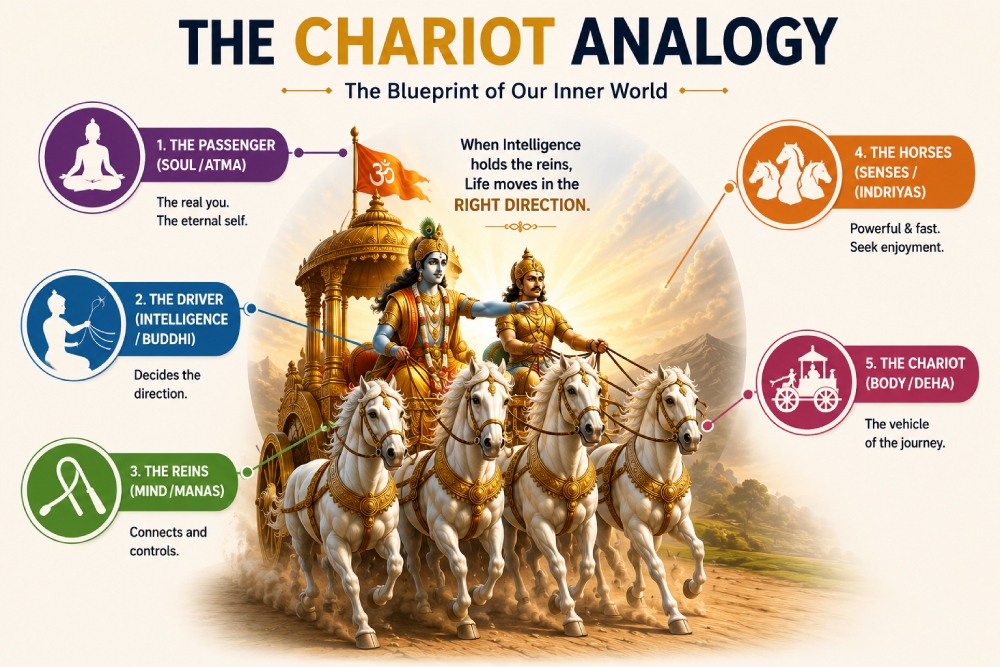
What Is the Chariot Analogy in Bhagavad-gita?
The Chariot Analogy from the Katha Upanishad compares the body to a chariot, the senses to horses, the mind to reins, intelligence to the driver, and the soul to the passenger.
The Passenger — The Soul (Atma)
The soul is the real self — the eternal conscious being seated within the body.
The Driver — Intelligence (Buddhi)
Intelligence helps us discriminate between right and wrong.
The Reins — The Mind (Manas)
The mind controls the direction of the senses.
The Horses — The Senses (Indriyas)
The senses constantly run toward enjoyment through sight, sound, taste, touch, and smell.
The Chariot — The Body (Deh)
The body is the vehicle through which we experience the world.
If the driver (intelligence) is weak or distracted, the reins (the mind) go slack. The horses then bolt toward whatever "grass" (sensory pleasure) they see, dragging the passenger into danger. A "Gita-reset" means strengthening the driver with spiritual knowledge so that the reins stay firm.
"If the mind loses control, the senses drag life in every direction."
What Does Bhagavad-gita Say About Controlling the Mind?
The Bhagavad-gita explains that the mind can become either our greatest friend or our worst enemy. Krishna teaches that through spiritual practice, self-discipline, hearing spiritual wisdom, and remembrance of God, the mind gradually becomes peaceful and controlled.
What Happens When the Mind Loses Control?
An uncontrolled mind creates:
• emotional instability
• impulsive decisions
• overthinking
• anger
• anxiety
• addiction to distractions
• lack of inner peace
Without proper guidance, the senses pull the mind in different directions every day.
The result is confusion, exhaustion, and dissatisfaction.
✦ Key Takeaway
The Bhagavad-gita teaches that mental peace begins when the mind is guided by spiritual intelligence instead of uncontrolled senses.
The Anatomy of a Thought
Before we can apply the cure, we must understand how the "infection" of an uncontrolled mind spreads. Krishna provides a psychological roadmap of how a single thought can lead to a total life collapse.
How Does the Mind Gradually Lose Control?
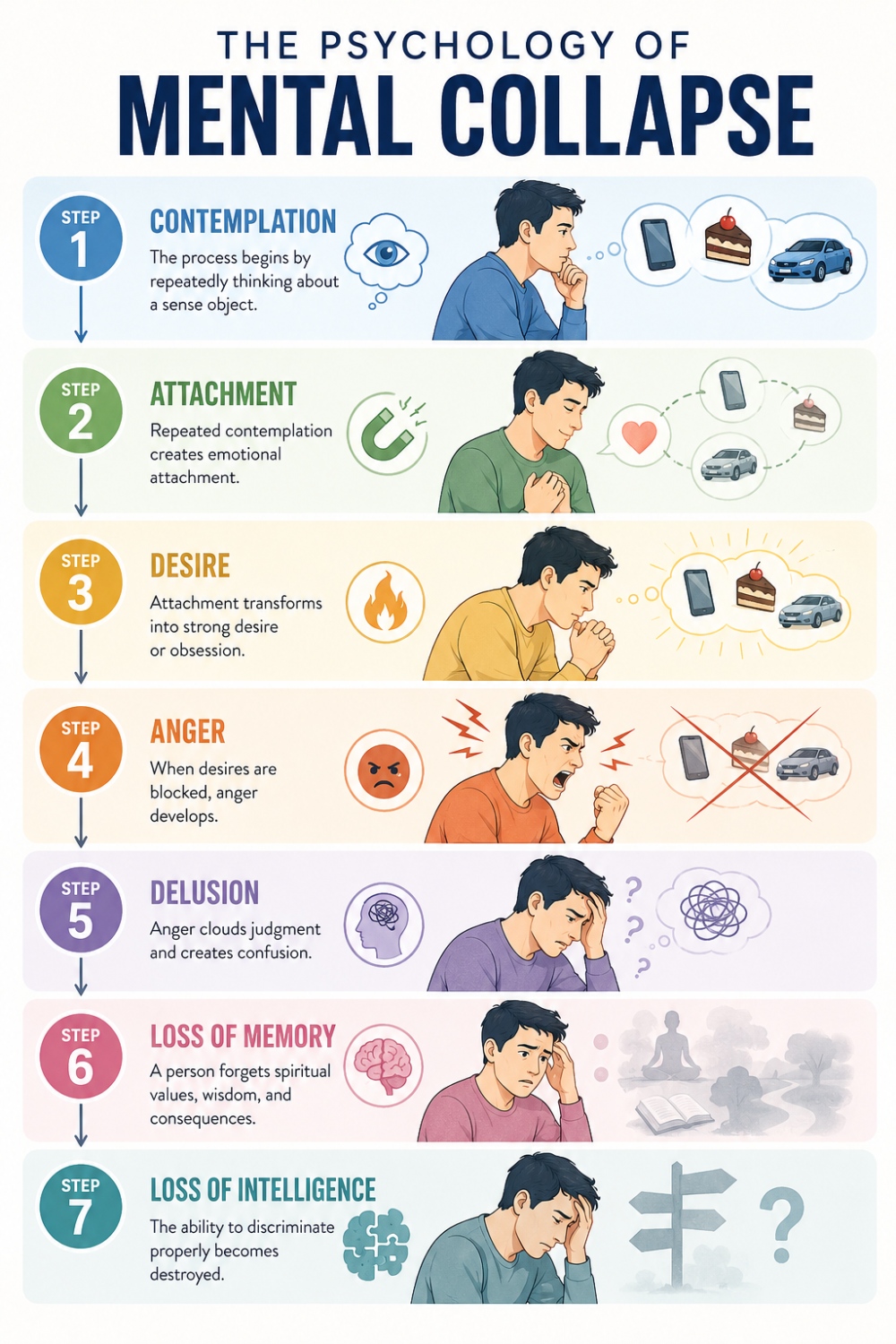
The Psychology of Mental Collapse
Lord Krishna explains how a single thought can gradually lead to suffering and downfall.
Step 1 — Contemplation
The process begins by repeatedly thinking about a sense object.
Step 2 — Attachment
Repeated contemplation creates emotional attachment.
Step 3 — Desire
Attachment transforms into strong desire or obsession.
Step 4 — Anger
When desires are blocked, anger develops.
Step 5 — Delusion
Anger clouds judgment and creates confusion.
Step 6 — Loss of Memory
A person forgets spiritual values, wisdom, and consequences.
Step 7 — Loss of Intelligence
The ability to discriminate properly becomes destroyed.
✦ Key Takeaway
Mental control begins at the thought level. Once contemplation turns into anger and attachment, the mind begins controlling the person.
The Three Modes of Nature (Tri-Guna) That Influence the Mind
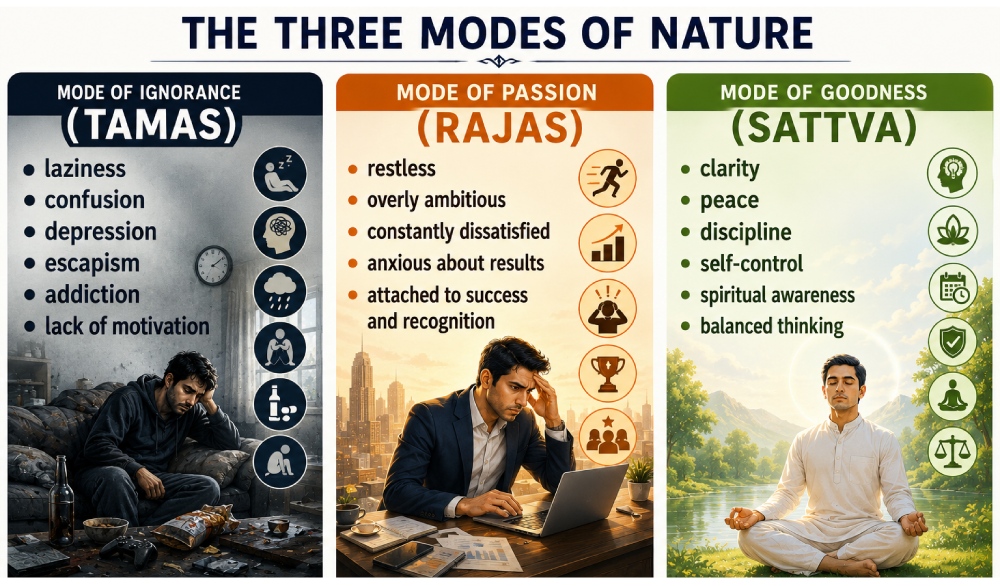
According to the Bhagavad-gita, the mind is influenced by three qualities of material nature called the three gunas.
Mode of Ignorance (Tamas): The mind is lazy, depressed, and prone to intoxication.
Mode of Passion (Rajas): The mind is overly ambitious, restless, and driven by "I, me, and mine."
Mode of Goodness (Sattva): The mind is calm, clear, and focused on truth
Our mind acts according to the "mode" influencing it. Srila Prabhupada teaches us to "tune" our mental frequency. To reset the mind, we must move it towards Sattva through clean living and spiritual study.
The "Reset" Strategy: Krishna’s Formula to Reset the Mind
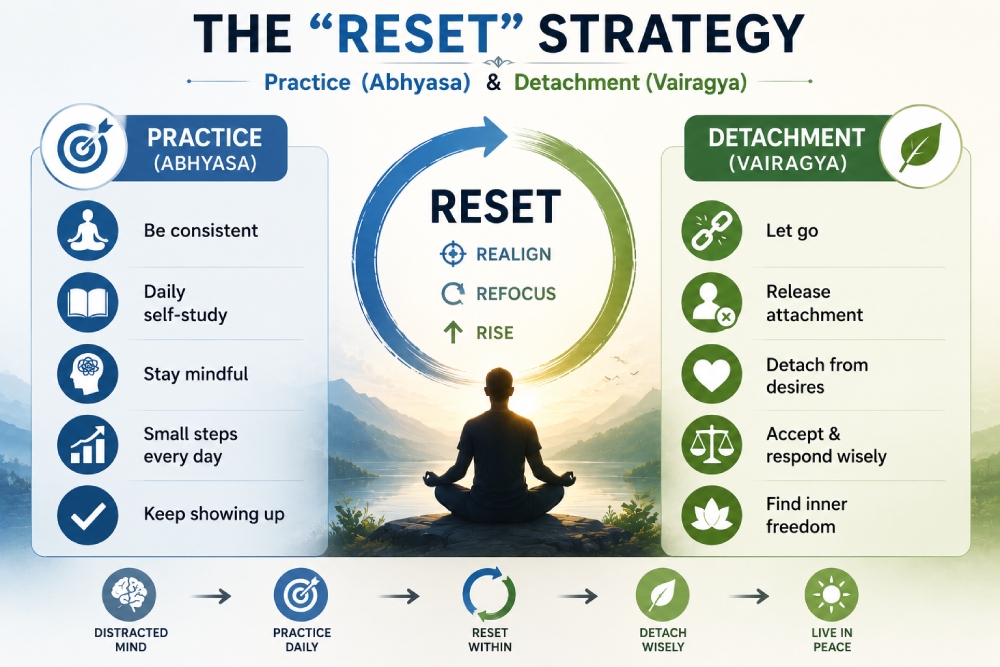
How do we practically take back the reins? Krishna gives Arjuna (and us) a two-part formula:
1. Practice (Abhyasa)
The mind must be repeatedly trained to return toward spiritual consciousness.
2. Detachment (Vairagya)
The mind must gradually lose attraction toward temporary distractions.
This process does not happen overnight. It develops through daily spiritual practice
The 3 Powerful Practices (Abhyasa) to Control the Mind
In his purport to Chapter 6, Text 35, Srila Prabhupada explains that "practice" in this age means engaging the mind in the nine processes of devotional service (Nava-vidha Bhakti).
The Nine Gates of Control: The Srimad Bhagavatam (7.5.23) lists these methods: Shravanam (Hearing), Kirtanam (Chanting), Smaranam (Remembering), Pada-sevanam (Serving), Archanam (Worshipping), Vandanam (Praying), Dasyam (Servitude), Sakhyam (Friendship), and Atma-nivedanam (Surrender).
While all nine are powerful, the "Reset" begins with the first three:
1. Shravanam (Hearing): This is the first and foremost engagement and the foundation of all control. Prabhupada often said the mind is like a clear mirror covered in dust; Shravanam is the process of wiping that dust away. When we hear about Krishna’s names, pastimes, and instructions, the mind becomes naturally attracted to Him. Thus we “reprogram” the subconscious mind through the power of Hearing.
2. Kirtanam (Chanting): The Sound Vibration of the Holy Name (Hare Krishna) acts as a spiritual anchor. It "locks" the mind onto the spiritual platform, preventing it from drifting into material agitation. This vibration penetrates the layers of the false ego to directly purify the consciousness (ceto-darpana-marjanam).
3. Smaranam (Remembering): This is where the mind is truly transformed. The Padma Purana gives us the ultimate rule for mental control: "Smartavyah satatam visnur vismartavyo na jatucit"—one should always remember Krishna and never forget Him. Once we repeatedly hear and chant, the mind naturally enters the state of Smaranam, or constant remembrance. By never forgetting Krishna, we leave no vacuum for the "enemy" mind to wander and plant seeds of material distractions or worldly attachment.
Detachment (Vairagya) through "The Higher Taste": Many people fear "detachment," thinking it means a dry, empty life. However, Prabhupada clarifies the secret to success in his 6.35 purport:
"The more one hears about Krishna, the more one becomes detached from everything that draws the mind away from Krishna."
The mind cannot be kept empty; it must be occupied. You cannot stop the mind from desiring by force; you must give it something better to desire.
Krishna confirms this in BG 2.59: "By experiencing a higher taste, he is fixed in consciousness."
By engaging in Shravanam, Kirtanam, and Smaranam, the mind naturally loses interest in lower, flickering pleasures. This is the ultimate Reset.
Conclusion: Reclaiming Your Peace
Controlling the mind is not a one-time event; it is a daily, moment-by-moment choice. As we engage the mind in Krishna, it naturally detaches from matter.
When you control your mind, you move from a state of agitation to a state of peace. Let us begin by taking one small step to practice this simple reset : the moment you notice the mind drifting into worry, anger or anxiety, consciously bring it back and "lock" the mind through the sound vibration of the Hare Krishna Maha-mantra. Let the words of Krishna reclaim the reins of your life. Choose to be the master of your mind, not its servant.
The reset begins now.
"For him who has conquered the mind, the mind is the best of friends; but for one who has failed to do so, his very mind will be the greatest enemy" - Bhagavad-gita 6.6
Ready to Start Your Inner Reset Journey?
👉 Join our Basic Gita Course and begin your spiritual reset journey today.
Frequently Asked Questions
1. What does the Bhagavad-gita say about Mind Control?
The Bhagavad-gita explains that the mind can become either our greatest friend or our worst enemy. Krishna teaches that through spiritual practice, discipline, hearing spiritual wisdom, and remembrance of God, the mind gradually becomes peaceful and controlled.
2. Why is the mind difficult to control according to Krishna?
Krishna explains in the Bhagavad-gita that the mind is naturally restless, emotionally instable, and difficult to control because it constantly runs toward distractions, desires, and temporary pleasures.
3. What causes overthinking according to the Bhagavad-gita?
The Bhagavad-gita explains that overthinking begins with repeated thinking on material desires and attachments, which gradually create anxiety, restlessness, and mental disturbance.
4. How to stop overthinking spirituality?
According to the Bhagavad-gita, overthinking can be reduced by redirecting the mind toward spiritual consciousness. Practices such as chanting the Hare Krishna Maha-mantra, hearing Bhagavad-gita wisdom, meditation, prayer, and remembering Krishna help calm mental disturbance and create inner peace.
5. What is Krishna’s solution for a restless mind?
Krishna recommends two primary methods for controlling the restless mind: practice (Abhyasa) and detachment (Vairagya). Through consistent spiritual practice, the mind gradually becomes stable.
6. How does spiritual wisdom create mental peace?
According to the Bhagavad-gita, spiritual wisdom creates mental peace by helping us understand our true identity beyond the body and temporary material problems. Spiritual wisdom redirects the mind from temporary pleasures toward lasting inner peace.