
The 9 Stages of Bhakti — A Journey of the Soul
Bhakti is not something we switch on one day, it is a gradual transformation. A slow, honest journey where the heart is purified, softened, and finally filled with divine love; like a small seed of faith growing gradually to the highest stage of divine love.
The scriptures describe this transformation in Nine Stages, wherein each stage reflects not just spiritual progress, but an inner shift we can actually feel:
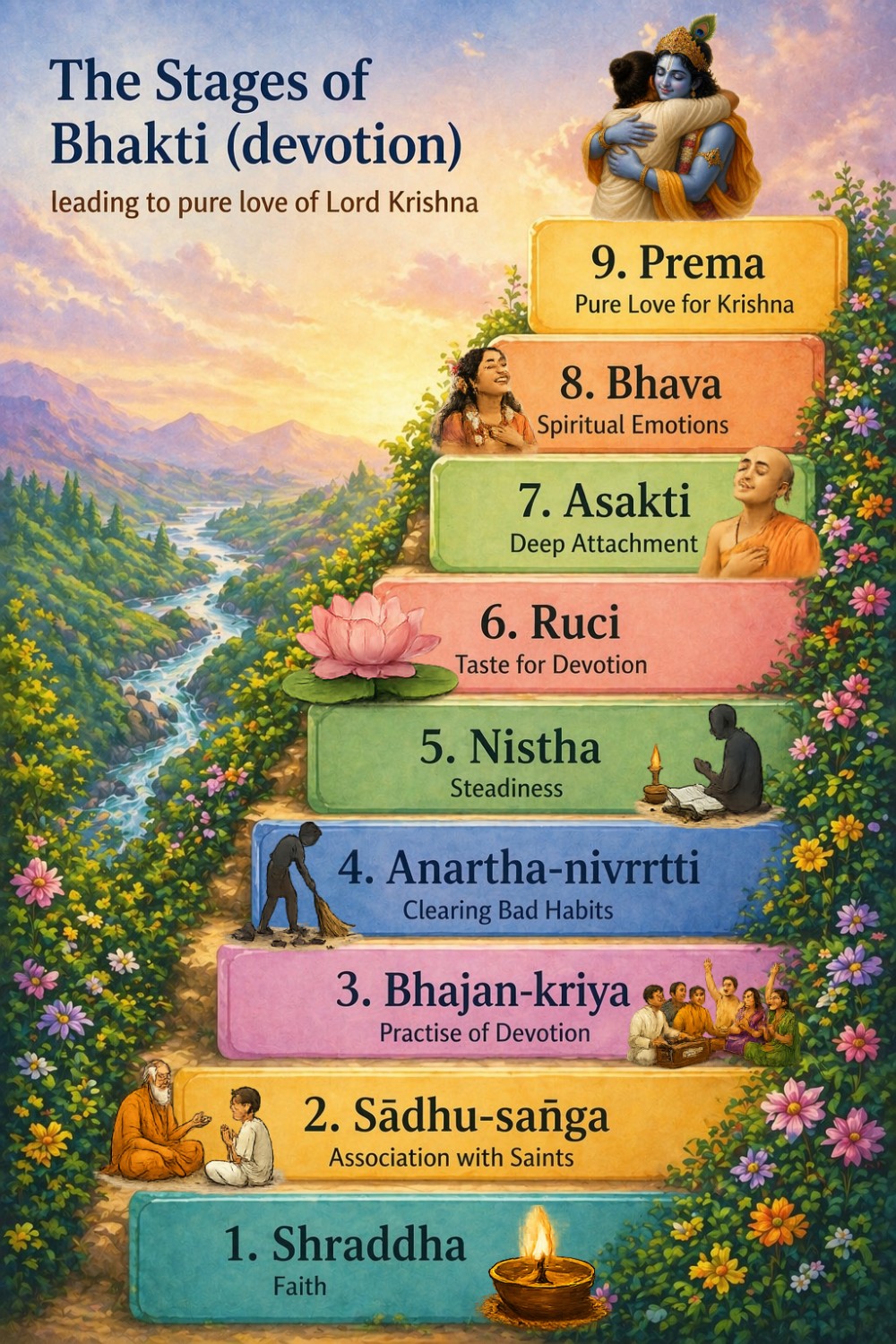
1. Shraddha (Faith)
It often begins with a quiet questioning within. Who am I, really? Why do these problems keep coming? What is the purpose of my life? Is there something higher that I haven’t understood yet?
These thoughts may come in moments of struggle or stillness, but they awaken a gentle curiosity.
From that curiosity, a small faith begins to grow, a feeling that there is more to life than what we see, and that there is some higher power is present which is lovingly moving and guiding everything.
2. Sadhu Sang (Association)
As faith grows, we naturally begin to seek the company of devotees. Gradually, we may feel less drawn to materialistic conversations or environments that once attracted us.
It’s not about rejecting people, but about the heart searching for deeper, more meaningful connection — where Krishna is remembered, and our spiritual desire is nourished.
We start seeking those who are walking this path. Their words, their presence, their lives begin to influence us in ways we didn’t expect.
3. Bhajan Kriya (Practice)
What once inspired us now asks for commitment. We begin to shape our life around devotion like setting time for chanting, hearing, and service.
Some days feel uplifting, others feel mechanical or distracted. We may struggle with consistency, laziness, or doubt… yet we continue. This stage is not about perfection, but about showing up again and again — because somewhere within, we know this is where we truly belong.
4. Anartha Nivritti (Inner Cleansing)
As we continue our practice, we begin to see ourselves more clearly.
Our Habits, distractions, ego, attachments and things we never questioned before, start coming to the surface. This stage can feel uncomfortable, even discouraging at times, as if we are becoming more aware of our imperfections.
But in reality, this is a sign of progress. What was hidden is now being revealed so it can be healed. With sincerity and patience, these unwanted patterns slowly loosen their hold, making space for something purer to grow within.
5. Nishtha (Steadiness)
After moving through inner struggles, a quiet strength begins to develop. We may still experience ups and downs, but they no longer control our devotion.
Practice is no longer dependent on mood, convenience, or external situations — it becomes a conscious, steady choice. Doubts lose their intensity, distractions lose their pull, and there is a growing sense of clarity and direction.
This stage feels like becoming anchored, where one continues not out of pressure, but out of deep inner conviction.
6. Ruchi (Taste)
With consistent practice, a gentle shift begins within.
What once felt like a routine or effort now begins to feel nourishing and meaningful. The heart starts to find joy in chanting, hearing, and serving. It is no longer about “I have to do this” — it becomes “I want to do this.”
There is a natural attraction, a subtle sweetness in devotion, where the soul begins to truly relish the path.
7. Asakti (Attachment)
The relationship with the Lord now moves from practice to deep inner connection.
Thoughts naturally return to Him again and again not out of discipline, but out of affection.
Worldly attractions start losing their grip, not because they are forcefully rejected, but because something higher has captured the soul. There is a quiet longing, a sense of belonging… as if the soul has finally found where it truly wants to be.
8. Bhav (Spiritual Emotion)
In this stage, a deep softness begins to live within the heart.
Devotion is no longer just something we do, it becomes something we feel. Lord Krishna feels really close, like a constant, loving companion.
At times, even a small remembrance, a name, or a prayer can touch us in unexpected ways. There is natural humility, gratitude, and a quiet longing that cannot always be explained. It’s like the first light of sunrise, where the soul begins to taste what it was always searching for.
9. Prema (Divine Love)
The final blossoming of the soul, where love flows without condition, expectations and desires. Love exists in its purest form, selfless, constant and in abundance.
The soul no longer lives for itself, every thought, every breath, every moment exists only for Lord Krishna. There is no trance of “What about me?” it’s only about “how may I serve you my dear Lord?” It is the highest perfection of devotion, where love flows so naturally and deeply that there is no separation between the lover and the beloved.
There is both deep peace and intense longing, a paradox that only the soul can understand. Here, the journey ends, and real life begins.
This journey of bhakti is not just a path we follow, it is a gentle return to where we truly belong.
From restlessness to peace
From searching to finding where we truly belong
From self-centered living to selfless love
This journey gradually transforms us as every stage (even the difficult ones) is the part of something sacred. And in the end, we realize… we were never trying to reach the Lord alone — He was gently, patiently drawing us back to Him all along.
Which Stage of Bhakti Are You In?
Are you simply exploring spirituality, building a daily practice, or developing a deeper connection with Krishna?
Take this short quiz to discover your current stage on the path of bhakti and learn what the next step could be.
👉 Start the Quiz
If you enjoyed reading this blog, share it with your loved ones and spread the wisdom of the Bhagavad Gita.
🙏 With love and devotion,
🌿 Hare Krishna!