
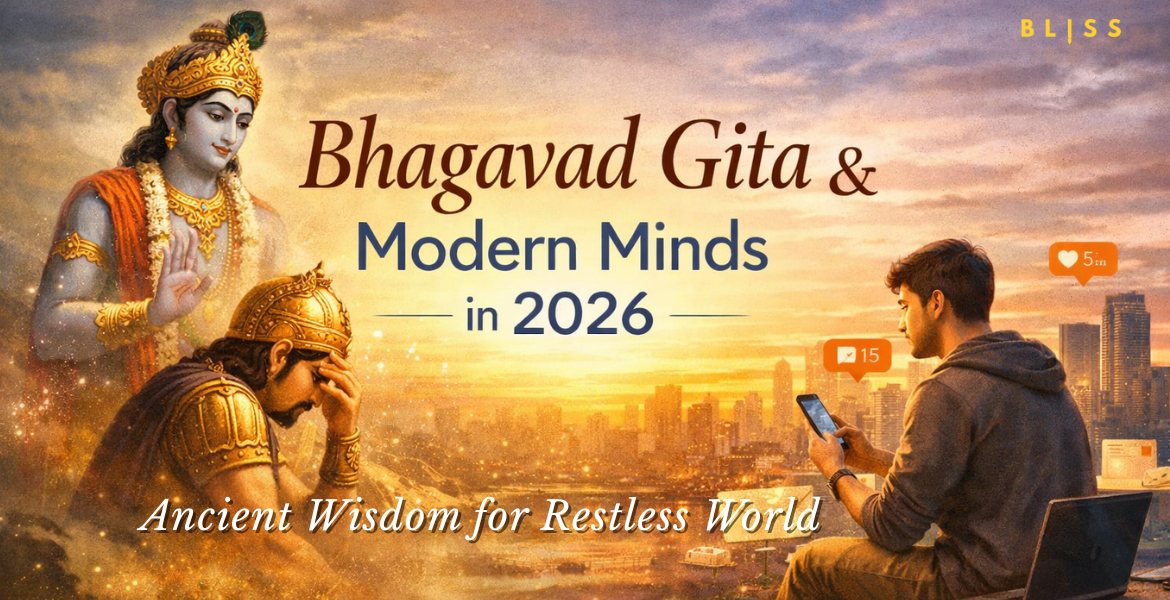
Bhagavad Gita and Modern Minds in 2026
In 2026, life is faster than ever. People know what they should focus on —exercise, meditation, positivity. But the mental health is still suffering. Modern minds are full of new thoughts and worries like career pressure, job, relationships, money, and success. Stress, overthinking, comparison, fear of failure, are common problems for modern youth.
Despite having access to digital world, people are still confused about life direction and purpose. We have lots of information, the world is connected at our fingertip, still there is a lack of clarity and inner peace. This is where the Bhagavad Gita, spoken thousands of years ago, becomes relevant for the modern age.
One reason the Bhagavad Gita still feels relevant is it begin when confusion arises. It doesn’t start with peace, wisdom, or solutions. It begins when Arjuna was mentally overwhelmed in battlefield and was unable to decide what to do.
The Modern Mind Is Always “Thinking”
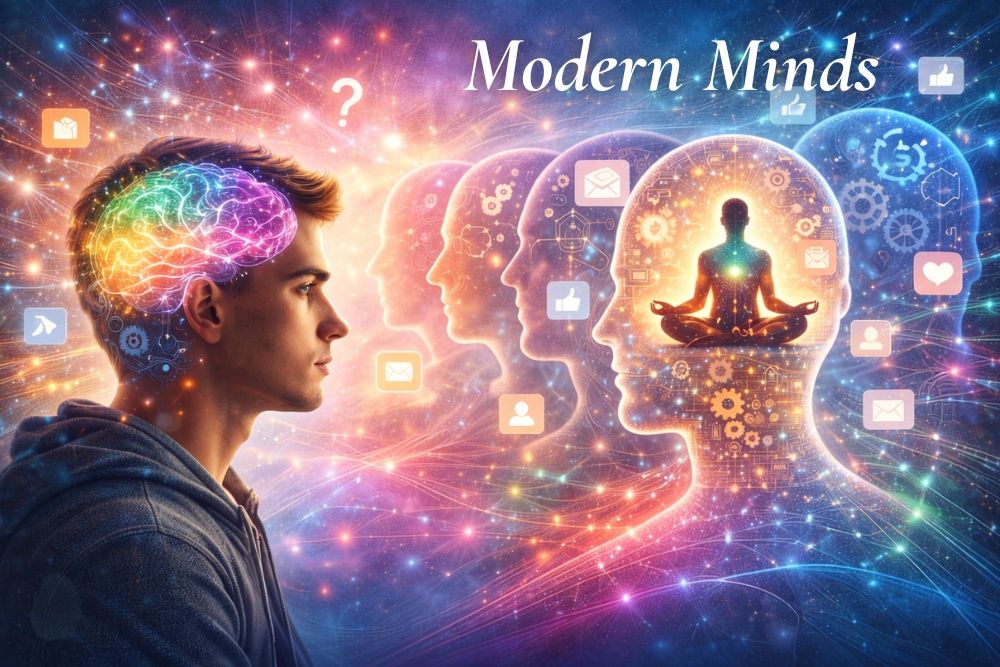
Today, the mind rarely stays where the body is, we call it lack of concentration. While working, it worries about the future, while resting, it feels guilty about past, while scrolling, it compares with others. One of the biggest struggles today is overthinking. The mind keeps jumping between past regrets and future worries. The mind replays conversations, unfinished thoughts, tomorrow’s tasks. This restlessness often leads people to believe something is wrong with them.
In Bhagavad Gita, the mind is observed like a water, it keeps moving. Krishna points out that the mind can be restless and difficult to manage. Instead of fighting the mind, one starts observing it. Its called a stage of awareness.
In Gita, Arjuna admits at one point, “My mind is confused about my duty. Please guide me.” (BG 2.7). That was not utter surrender, but acceptance. Arjuna found relief the moment he stopped fighting his inner confusion and allowed it to be fully seen.
In 2026, most people don’t suffer because life is unbearable. They suffer because they don’t allow themselves to be where they are. The Bhagavad Gita quietly shows that awareness is not a technique, It is the end of resistance. We may not be able to control everything happening around us, but we can learn to work with what happens within us.
Why Results Exhaust Us More Than Work
Today, everything is about results—marks, salary, promotions, followers, and approval from others. Most people don’t hate duties. They hate the mental load attached to it.
With constant distractions shaping our thoughts, stress no longer feels like an exception—it feels normal. A single ‘unseen’ message can disturb the mind for hours, One minor mistake feels like a life failure. The exhaustion isn’t physical. It’s emotional attachment. This constant pressure creates stress and fear.
Pressure comes from:
• Fear of failure
• Constant evaluation
• Need to prove oneself
You can finish a task and still feel tired because the mind keeps thinking about result. This mental replay drains more energy. Arjuna’s exhaustion on the battlefield wasn’t also physical, It was emotional — fear of consequences, judgment, and loss.
The Gita teaches something very practical: “Focus on doing your work sincerely. Don’t be too anxious about results.”
The Gita shifts the source of satisfaction: From “What did I get?” To “How sincerely did I act?”. The Gita’s emphasizes in on realizing self-worth. When you give your best without attaching your happiness to outcomes, the mind feels lighter.
Confusion Isn’t Lack of Direction, It’s Too Many Choices
In 2026, everyone has an opinion. Social platforms are flooded with people who offer Career advice, Relationship advice, Productivity advice, Spiritual advice. A student scrolls through career options—MBA, startup, freelancing, studying abroad. Each choice looks promising. The mind keeps asking: What if I choose wrong? What if the other option was better?. Each thought pulls the mind in a different direction.

The Gita doesn’t provide the answers for what to choose. It points to the state of the mind. It teaches that clarity comes when decisions are made from inner stability, without comparison.
Arjuna wasn’t confused because he lacked guidance. He was confused among too many choices: Duty, emotions, fear, attachment. There’s a moment where Krishna tells Arjuna that clarity comes when the mind is steady. He helped Arjuna center the mind, so choice could arise from clarity. Bhagavad Gita describes a mental condition, When there are multiple choices, confusion grows. When the mind stops jumping, direction appears naturally.
Clarity doesn’t come from the “best choice.” It comes from a mind that isn’t pulled in multiple directions at once. Instead of thinking "Which choice will give me the best future?" , focus on "What responsibility is clearly in front of me today?" That question alone removes many options.
Emotional Sensitivity in the Digital Age
In 2026, emotions are triggered faster than ever. Mood shifts instantly. They are triggered by screens. The mind has no time to digest one emotion before another appears. One post or notification can change your emotional state. This is not because people have become weak. It is because emotions are now constantly stimulated. It’s about over-exposure.
Feeling happy, sad, hurt, excited, or disappointed is completely natural. The Gita does not ask us to suppress emotions or become emotionless. it helps us understand why constantly reacting to the outside world makes emotions heavier. When we don’t get reply to our message immediately, the mind fills with assumptions. The Gita simply helps us notice this process before we believe it. Through mindfulness and meditation, we begin to observe our thoughts instead of being driven by them and focus our energy on actions that are helpful rather than harmful.
Why the Gita Still Speaks in 2026?
Gita doesn’t offer motivation or shortcuts. The Bhagavad Gita remains relevant not because it fits modern trends, but It helps us understand why life feels mentally heavy—even when things are going fine. In 2026, the mind has no time to pause. From the moment we wake up, the senses are active. Even when nothing urgent is happening, the mind keeps imaging the things. Because of this, emotions don’t get space to complete.
The Bhagavad Gita simply recognizes this human mechanism. It doesn’t blame technology, emotions, or trends. It quietly points out that when attention is scattered, inner stability declines. When attention is allowed to rest, emotional balance naturally returns.
"The Bhagavad Gita doesn’t try to fix the world around us. It teaches us how to remain steady while the world keeps moving."
If some of these thoughts felt familiar, it’s not because something is wrong with you. It’s because modern life rarely teaches us how the mind actually works.
At BLISS, we explore these ideas through the Bhagavad Gita teachings—not as philosophy, but as practical understanding. If you’d like to go deeper, you may explore our guided courses designed for modern minds.
👉Looking for structured Gita learning? Explore our Bhagavad Gita Classes Online
Frequently Asked Questions
1. How is the Bhagavad Gita used in today’s life?
In today’s life, the Bhagavad Gita is used as a guide for understanding the mind, emotions, and decision-making. It emphasizes Karma Yoga, acting responsibly without being mentally attached by results. Through Bhakti Yoga it supports inner connection and emotional balance. While Dhyan Yoga is especially relevant in the digital age to obtain awareness and steadiness of the mind.
In a fast-paced, digital world, the Gita offers practical insight on how to stay mentally steady while engaging fully with daily responsibilities.
2. What is the role of the Bhagavad Gita in our society?
In society, the Bhagavad Gita offers a foundation of dharma, ethical action without being overwhelmed by fear, pressure, or outcomes. It teaches principles like duty, selflessness, and mindfulness, and inspire people to contribute positively to their communities.
3. Can Bhagavad Gita help to stop overthinking and negative thoughts?
Yes. The Bhagavad Gita teaches that the mind becomes an enemy when it is uncontrolled and a friend when guided with consciousness. Rather than suppressing thoughts, the Gita encourages to guide the mind with awareness through simple shifts. Instead of reacting to every notion, just observe the emotions as they arise, create the moments of serenity, and allow the mind to settle naturally. This practice helps the mind become calmer and more stable.
4. How does the Bhagavad Gita help with decision-making today?
The Gita encourages decision-making from inner clarity (buddhi) rather than emotional instinct. Through Karma Yoga, the Gita teaches us to focus on doing our duty sincerely, without constantly worrying about results. This makes decisions making more easy and stress-free, as there is no fear of success or failure.
5. Why Gita emphasizes to focus on actions and not outcomes?
As per Gita, focusing on actions is more important, because result depends on various external factors which are not in our control. What we can control is our sincere effort and intention towards work. Less expectations reduces stress and ego. The Bhagavad Gita inspires us for such selfless actions to keep us humble and peaceful.
If you enjoyed reading this blog, share it with your loved ones and spread the wisdom of the Bhagavad Gita.
🙏 With love and devotion,
🌿 Hare Krishna!