

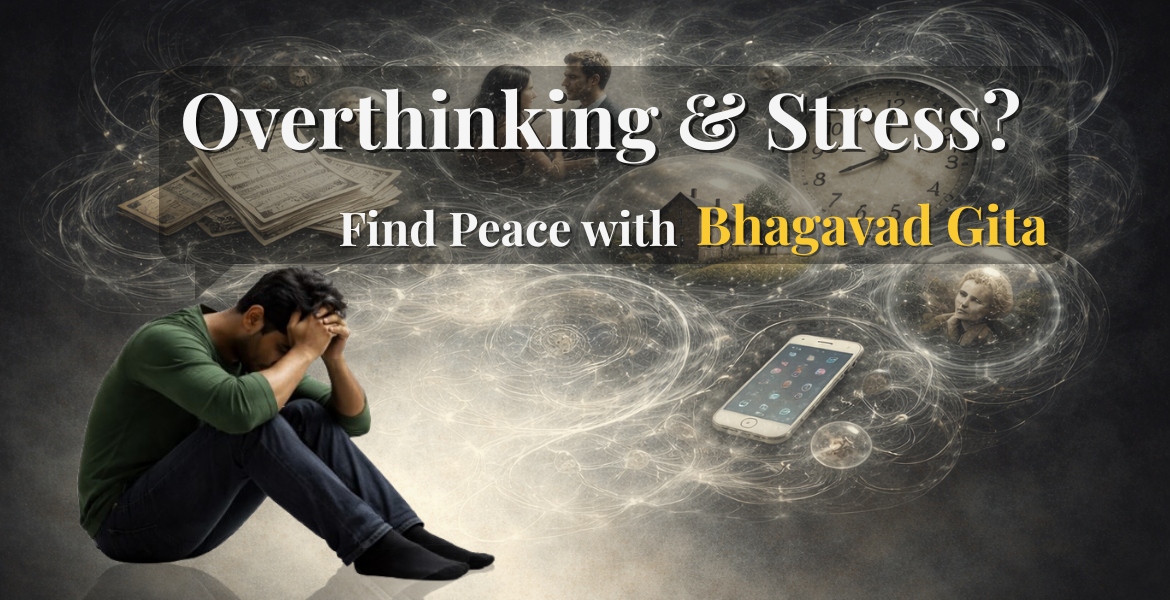
6 Powerful Bhagavad Gita Teachings to Overcome Stress and Anxiety
We often feel overwhelmed by stress, anxiety and constant pressure from work, relationships and expectations. If we see closely, these emotions have become common for many people round us, teenagers and even for kids.
But surprisingly, these struggles are not new! 5 thousand years ago, on the battlefield of Kurukshetra, Arjuna faced a deep emotional and mental crisis. Overwhelmed by grief and anxiety, he became indecisive and was unable to determine what the right course of action was.
At different points in our lives we too find ourselves overwhelmed by confusion, anxiety, depression and sometimes we get so much lost in the loop of these problems that we find it difficult to even do our daily task efficiently.
Why Arjuna Felt Stress and Confusion?

Seeing his relatives, teachers and friends on the battlefield, Arjun feels intense grief and confusion. He describes the symptoms that many people experience during anxiety: trembling body, dry mouth, and an inability to think clearly. In such overwhelming situation even a great warrior like Arjuna experiences mental stress and even refuses to perform his duty, but he did not actually quit. What he did to deal with his delusion is something we all should learn and follow.
So instead of not performing his duty, he actually surrendered himself to the Lotus Feet of Lord Krishna. Surrender to the Lotus Feet of Lord Krishna is the Key to unlock ourselves from all the problems.
When Lord Krishna takes charge of our lives, everything falls into its right place; as He is the supreme protector of all living entities.
The guidance given by Lord Krishna to help Arjuna overcome his mental turmoil are equally relevant for us in this modern age as well.
Let’s try to unfold these teachings: -
1. How Bhagavad Gita helps to Handle Temporary Situations in Life?
Bhagavad Gita 2.14
"O son of Kuntī, the nonpermanent appearance of happiness and distress, and their disappearance in due course, are like the appearance and disappearance of winter and summer seasons. They arise from sense perception, O scion of Bharata, and one must learn to tolerate them without being disturbed."
Here we have to focus on the word Tolerate because if we try to tolerate the distress situation without being disturbed then we can remain steady even during big challenging circumstances. So Lord Krishna teaches that happiness and distress are temporary and should be tolerated with patience.
Example: A person may feel very stressed after losing a job or facing failure in a project. At that moment, the situation may seem overwhelming. However, just as seasons eventually change, difficult phases in life also pass with time. By remembering this teaching of the Bhagavad Gita, one can develop patience and face challenges with a calmer mind.
2. How to Reduce Stress by Letting Go of Results?

Bhagavad Gita 2.47 - A Path to Detachment
"You have a right to perform your prescribed duty, but you are not entitled to the fruits of action. Never consider yourself the cause of the results of your activities, and never be attached to not doing your duty."
Another major cause of stress is excessive attachment to results. Krishna advises Arjuna to focus on sincere effort while leaving the results to the Supreme.
We have control over our effort and actions, but the results are ultimately not in our hands. When we become overly attached to the outcome, it creates fear, pressure, and anxiety.
We should focus on performing our duty sincerely and responsibly, without attachment to the results. By doing so, we can act with greater clarity and peace of mind.
Moreover, we should not think that we are the ultimate cause of the results we get. Many factors beyond our control influence the outcome of our efforts. Understanding this helps a person act sincerely without becoming overwhelmed by stress or anxiety.
Example: A student may feel anxious before an exam because they are constantly worrying about the result. According to this teaching, the student should focus on studying sincerely and doing their best, rather than becoming overly attached to the outcome. This mindset reduces unnecessary stress and allows them to perform better.
3. How Spiritual Knowledge Overcome Fear and Anxiety?
Bhagavad Gita 2.20 - Understanding the Eternal Soul
"For the soul there is neither birth nor death at any time. He has not come into being, does not come into being, and will not come into being. The soul is unborn, eternal, ever-existing and primeval. He is not slain when the body is slain."
Many forms of anxiety arise because we identify ourselves only with the body and the temporary circumstances of life. Fear of loss, fear of death and fear of change can disturb the mind.
This verse helps shift our perspective from temporary things to eternal matters. Lord Krishna explains here that the real self is the soul, which is eternal and beyond the temporary body. When we realize this and continue to exist beyond the temporary body, many fears begin to lose their intensity. This spiritual understanding brings deeper stability and peace.
Example: When people lose a loved one, they often experience deep grief and anxiety because they believe everything has ended. However, the Bhagavad Gita explains that the soul is eternal and continues its journey beyond the body. Understanding this spiritual truth can bring comfort and help a person cope with loss with greater strength and perspective.
Struggling with overthinking and anxiety? Discover practical Bhagavad Gita techniques to calm your mind.
👉 Join our beginner-friendly Bhagavad Gita Course
4. Why Accepting Life’s Reality Helps Reduce Confusion?
Bhagavad Gita 8.15 - Understanding the Nature of the Material World
"After attaining Me, the great souls, who are yogis in devotion, never return to this temporary world, which is full of miseries, because they have attained the highest perfection."
Another important teaching of the Bhagavad Gita is that the material world is naturally filled with temporary happiness and distress. Stress and anxiety often arise because we expect permanent happiness and stability from temporary situations. When circumstances change, the mind easily becomes disturbed.
This verse reminds us that the material world is described as “duḥkhālayam aśāśvatam”—a temporary place full of suffering. Understanding this truth helps a person develop a deeper perspective on life’s challenges.
When one connects with the Supreme through devotion, spiritual knowledge, and practices such as chanting the holy names, the mind gradually becomes peaceful and less disturbed by temporary difficulties.
Example: People often feel stressed when situations in life do not go according to their expectations—such as career setbacks, financial struggles, or personal challenges. The Bhagavad Gita reminds us that the material world naturally contains both happiness and distress. Understanding this helps a person develop patience and face difficulties with greater maturity.
5. How to Control Your Mind and Reduce Overthinking?

Bhagavad Gita 6.5 - Lifting the Mind
"One must elevate, not degrade, oneself with the help of the mind. The mind can be the friend of the conditioned soul, and his enemy as well."
The mind plays a central role in our happiness or distress. Learning to guide the mind through spiritual practice helps reduce anxiety. a person can gradually elevate themselves by learning to guide the mind toward higher understanding. But how to do it? Practices such as chanting the holy names of the Lord, constant inflow of knowledge and wisdom, reading thought provoking books (Bhagavad Gita) and focusing on our duty help bring the mind under control.
When the mind becomes steady and spiritually focused, it no longer creates unnecessary thoughts instead supports a peaceful and balanced life.
If you are new to these practices, you can also explore how to start a spiritual journey as a beginner to build a simple and consistent routine in daily life.
Example: In daily life, when a person repeatedly thinks negative thoughts such as fear of failure or constant worry about the future, the mind becomes a source of anxiety. However, by practicing meditation, prayer, or positive spiritual reflection, the same mind can become supportive and help maintain inner peace.
6. How to Stay Calm in Stressful Situations?
Bhagavad Gita 12.15 - Freedom from Anxiety
"He by whom no one is put into difficulty and who is not disturbed by anyone, who is equipoised in happiness and distress, fear and anxiety, is very dear to Me."
A spiritually mature person develops a calm and balanced mind. Such a person does not create disturbance for others, nor do they become excessively disturbed by the actions of the world around them. Their inner stability comes from spiritual understanding and faith in the Supreme Lord.
Actually anxiety often arises when the mind becomes attached to external situations, expectations, or the opinions of others. However, when a person develops devotion and trust in the guidance of the Lord, they gradually become more steady and peaceful.
Example: A person who remains calm during difficult situations at work or in family life, without becoming overly disturbed or causing disturbance to others, reflects the qualities described in this verse. Such inner balance helps maintain harmony and reduces anxiety in relationships and responsibilities.
Conclusion: How Bhagavad Gita Brings Inner Peace and Clarity?
There are so many more verses in Bhagavad Gita which can help us overcome from day to day worries and restlessness. Like how it worked for Arjuna, as in BG 18.73, Arjuna declares, “My dear Krishna, my illusion is now gone. I have regained my memory by your mercy. I am now free from doubt and prepared to act according to your instructions."
This powerful statement shows that spiritual wisdom has the ability to remove confusion and restore inner strength.
So, the Bhagavad Gita begins with Arjuna in a state of confusion, grief, and delusion, unable to decide the right course of action. However, by hearing the wisdom of Lord Krishna, his doubts were gradually removed and he regained clarity and determination.
In many ways, Arjuna’s situation reflects the struggles that we experience today. The teachings of the Bhagavad Gita remind us that true peace does not come from external circumstances but from spiritual understanding and connection with the Supreme.
Thus, the Bhagavad Gita is not merely a philosophical text but a timeless guide that continues to help people navigate the challenges of life with wisdom, faith, and inner strength.
FAQs on Bhagavad Gita for Stress and Anxiety
Q1. Can the Bhagavad Gita actually help reduce stress and anxiety?
Yes, the Bhagavad Gita offers practical wisdom to reduce stress and anxiety by teaching detachment, self-control, and clarity of mind. Its teachings help individuals focus on their actions rather than results, which reduces stress and emotional disturbance in daily life.
Q2. Which Bhagavad Gita shloka is best for stress relief?
One of the best Bhagavad Gita shlokas for stress relief is Chapter 2, Verse 47, which teaches focusing on your actions without worrying about results. Another powerful verse is 2.14, which explains that happiness and suffering both are temporary, helping you stay calm during stressful situations.
Q3. How does Bhagavad Gita help in controlling the mind?
The Bhagavad Gita chapter 6.5 explains that the mind can be both a friend and an enemy. By practicing discipline, meditation and detachment, a person can control negative thoughts, reduce anxiety, and develop a calm and focused mindset.
Q4. Can spirituality help with anxiety and mental health?
Yes, spirituality can play a powerful role in improving mental health and reducing anxiety. It helps shift focus from external problems to inner peace, builds emotional strength, and creates a self-awareness, which naturally reduces stress, fear, and overthinking.
Q5. What are practical ways to stop overthinking according to Bhagavad Gita?
To stop overthinking, focus on simple daily habits that calm and control the mind. Focus on your actions instead of worrying about results, as taught in the Bhagavad Gita. Limit negative inputs, and maintain a daily routine of chanting and meditation. Writing down your thoughts and practicing gratitude can also help clear mental stress and bring inner peace.
If you enjoyed reading this blog, share it with your loved ones and spread the wisdom of the Bhagavad Gita.
Ready to Train Your Mind?
Check how well you understood the Bhagavad Gita teachings on stress, overthinking, and mental peace.
Test yourself with the quiz based on this blog.
👉 Start the Stress & Anxiety Gita Wisdom Quiz
🙏 With love and devotion,
🌿 Hare Krishna!